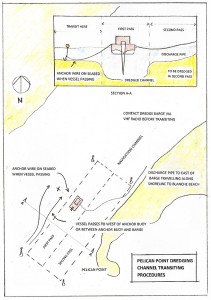
Pelican Point Dredging Transiting Procedures (click on image to see it full-size)
After a two week delay, dredging at Pelican Point will now commence on Friday 18th March. Full information is available on the MAST website, and the NOTICE TO MARINERS relating to the dredging transiting procedures can be downloaded from the same page.
The dredge equipment is currently at Stieglitz where the discharge pipe is being connected into long lengths, before being moved to the dredge site. This and the dredge barge will start to be moved to the site by Friday 18th, with pumping likely to commence on Saturday 19th March.
The dredging will be undertaken by Slurry Systems Marine using a cutter-suction dredge. This dredge consists of a barge approximately 8.0 metres long with a beam of approximately 3.0m.
During the period of dredging, which is expected to be 3-4 weeks, transiting of the channel will be restricted. It will be necessary to pass to the western side of the barge at all times. This includes times of dredging and other times of the day and night when dredging is not occurring, but the barge is moored in the channel.
The barge will exhibit shapes during the day and lights at night indicating dredge operations and that it is safe to pass to the west. Due to the discharge pipe to Blanche Beach, at no time will it be safe to pass to the east of the barge.
Normal working hours will be 07h00-17h00 daily, and it is likely that the contractor may operate seven days a week.
The channel will be dredged in two passes, with the western side of the channel being the first pass. During this time transiting vessels will be required to pass the barge to the west of the current channel. Due to limited depth in this area, it will be necessary to transit at high tide only.
During dredging it will be necessary to deploy an anchor approximately 30 metres further west than the barge. Vessels can pass further west of this anchor, if depth allows, or pass between the dredge and the anchor. The anchor wire will be slack and on the bottom when vessels are passing.
The dredge operator will be monitoring VHF Channel 16 and will utilise another working channel to communicate further with vessels wishing to pass. It is important to notify them of your intending passage, particularly when travelling from the barway, as visibility astern from the barge will be limited.
Should you not be able to raise the Slurry Systems Marine dredge operator via VHF radio then the following mobile phone numbers apply (dredge operators will be rotating):
- Dave: Phone 0437 124 385
- Murray: Phone: 0400 175 791
- Lex: Phone: 0413 007 387
For further queries contact Justin Foster at MAST on 0418 142 053.


 BP Australia
 Break O'Day Council
 Crowe Horwarth
 Cruising Yacht Club of Australia
 Deegan Marine
 East Coast Auto Parts, Quail Street
 Fieldwicks Crushing and Screening
 Finance Brokers of Tasmania
 GM Consult
 Hunters Chemicals, Tasmania
 Lyndcraft Boats
 Moonraker Antenna Systems
 Scope Insurance Pty Ltd
 Tamar Marine, Launceston