Browsing Posts published by admin

Marine Safety Tasmania’s Strategic Plan for 2009/2010 makes provision for dredging work to improve access and safety across the St Helens Barway into Georges Bay:


“In the 2008 State Budget the Government announced a $2.4 million dollar funding package to improve access over the Georges Bay barway at St Helens.

This package follows an extensive program of consultation with the Break O’Day Council and local stakeholders from the commercial fishing and charter boat industries, recreational game fishers and recreational boaters. It is based on extensive technical advice on the causes of the problems at the barway and the options for improving access.

The improvement strategy is twofold. The first phase of the strategy is to try and remove the sand that is feeding the barway by taking up to 200,000 cubic metres of sand from Blanche Beach behind the rock training wall. The necessary environmental and planning approvals for the removal of sand was obtained in May 2009 and the construction works should be completed by August 2009.

The second phase is to carry out a program of dredging at Pelican Point within Georges Bay to remove the shoal within the main navigation channel. In May 2009 it became clear that environmental approval for a dredging process that involved placing dredge spoil at Pelican Point was unlikely to be granted. This means that MAST will revert to the “prop wash dredging” process that was carried out in 2006.

The steps required to implement the second phase of this project are to:

  1. Prepare tender documents for the “prop wash” dredging.
  2. Let the contract for dredging.
  3. Monitor the effectiveness of the removal of sand from Blanche Beach and the dredging operations at Pelican point.
  4. Determine if there are alternative options that may be required to maintain a navigable channel at Pelican Point.

In 2009/10 MAST will continue to develop a safe system to maintain access for vessels to St Helens through Georges Bay by:

  • Completion of the removal of sand from Blanche Beach by 15 September 2009.
  • Prepare tender documents for the “prop wash” dredging by 31 July 2009.
  • Let the contract for dredging by 31 August 2009.
  • Monitor the effectiveness of the removal of sand from Blanche Beach and the dredging operations at Pelican Point by a series of quarterly audits.
  • Determine if there are alternative options available to maintain a navigable channel at Pelican Point by 31 March 2010.

Marine Safety Tasmania has published a report titled “St Helens Barway Review & Update of Options“.

Coastal Engineering Solutions Pty Ltd (CES) was engaged by MAST to undertake a review of previous studies of The Barway at St Helens. The two primary outcomes required from the study are:

  1. Provide an opinion about the navigability of the barway and the channels within the
    entrance over the next five years without any intervention.
  2. Provide recommendations of long term solutions for improving navigation at the bar
    and entrance channels.

The report concluded that:

  1. Removal of sand from the beach to the east of the training wall is essential to prevent further build up of sand on the bars and shoals seaward of the training wall.
  2. St Helens will never be an all-weather port. The the limiting wave condition at The Barway for safe navigation is when the wave height in deeper water (7 metre depth) seaward of the bar is 1 metre. Even a channel depth maintained at -3 metres (LWD) may be difficult to navigate at times.
  3. Dredging of the barway can be undertaken using either agitation dredging or a suction dredge.
  4. Dredging of the shoals at Pelican Point can be undertaken using agitation dredging, sidecasting dredging with a suction dredge or by employing a small cutter suction dredge, if available.
  5. Environmental approvals would need to be obtained for any dredging operations.

St Helens Marine Rescue's Ageing Vessel, Sea Guardian

St Helens Marine Rescue's Ageing Vessel, Sea Guardian


Posted on ABC News on Friday 4 May 2007
Coast guard safety concerns because of ageing boat
The St Helens Marine Rescue says it will not be able to attend distress calls in larger seas in the near future because of its ageing boat, the Sea Guardian.

But the organisation has pulled out of a federal funding application to buy a new boat.

The Commander of the St Helens Marine Rescue, Ian Hollingsworth, says they are frustrated by the process and the boat they wanted has been sold.

“It’s just a continual process of chasing money to keep us up and running, we’ve sort of got a little tired lately and just at the stage where we need to take a deep breath and just assess what the situation is, and possibly look it a bit further down the track,” he said.

It needed $375,000 from the state and federal governments – the state committed $40,000 and the Liberal Senator Guy Barnett said he would back an application for federal funds.

Mr Hollingsworth says they will have to consider replacing the Sea Guardian soon.

“The possibility is that as it deteriorates slowly we can limit where we go and what we do, the boat has a lot of life left in it and we’ll be using quieter waters once we’re finished with it but it’s only a matter of time before we can’t take her out in the large seas we experience at times,” he said.

The Sea Guardian is a 48 foot Solent Class lifeboat and is a well recognised vessel on the Tasmanian East Coast, having towed dozens of boats to safety. She always performs at her best when seas are at their biggest. As an example of her capabilities, she has assisted one yacht 35 nautical miles north-east of Eddystone Point in winds gusting at over 70 knots.

Posted on ABC News Monday 3 October 2005

The St Helens Marine Rescue Association, formerly the coastal patrol, has a new asset to help save lives.

The $90,000 boat, the Break O’Day, took to the water for the first time this week.

The new boat is proof the former coastal patrol has landed on its feet after management seized its assets and stripped $30,000 from its bank account last year.

The money was eventually returned and the State Government bought back the assets.

The deputy commander of the St Helens Marine Rescue, Ian Hollingsworth, says the community contributed $68,000 towards the purchase of the Break O’Day.

“We couldn’t do it without the community, St Helens is absolutely fantastic when it comes to this sort of thing – we’re just forever grateful to the whole town and surrounding area,” he said

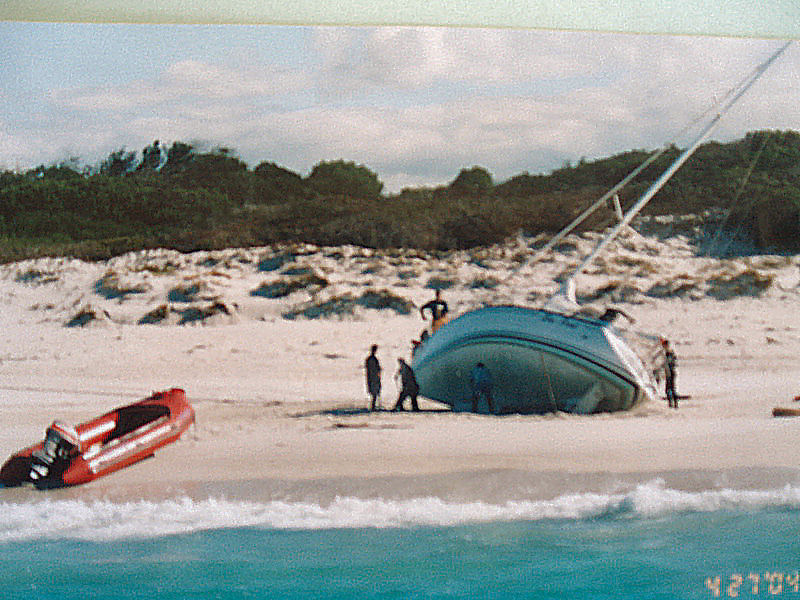
Blue Print on the Beach at Cod Bay

Blue Print on the Beach at Cod Bay

During April 2004 the yacht “Blue Print” was recovered from Cod Bay after running aground in stormy weather.

Blue Print had contact with St Helens Marine Rescue radio listening watch in the evening, reporting they were heading north and had a very strong southerly wind. At 11.30pm a Mayday call was heard by our standby station: Blue Print had hit a rock north of Eddystone Point, possibly Cabbage Rock. We immediately contacted Marine Police in St Helens, opened up base radios with the Tasmanian police and Marine Rescue crew and continued contact. The 2300 observation gave the wind strength at Eddystone as southerly at 65 knots.

Blue Print said they were taking water and believed they were inshore of Georges Rocks. This was most concerning as there are a number of navigation hazards in this area.Visibility was down to zero with a large sea.

The skipper then reported that the yacht had hit something hard and had stopped sailing. After a minute or so, they advised that they were going to abandon ship.

We sat at the radio with our hearts in out mouths,thinking only the worst could happen. Three minutes later Blue Print came back on the air reporting that they were up on the beach on the northern end of Cod Bay.

Sergeant Elwyn Williams and Constable Kevin Smith left St Helens immediately in a 4×4 to recover them, succesfully doing so in the early hours of the morning in very poor conditions.

The owner contacted St Helens Marine Rescue with a view to recovering Blue Print.
We thought the chance of recovery were good providing there was no significant damage.The yacht had to be removed as it was aground in the Mt William National Park.

The St Helens Marine Rescue vessel, Sea Guardian(Solent Class), skippered by experienced local fisherman Lance Barber, left St Helens to attempt a recovery. Sgt Williams and Constable Smith put the Police inflatable in at Eddystone Point. The inflatable was used to put crew onshore with tow ropes and equipment.

After arrival, an inspection of Blue Print revealed a crack on the hull along the keel, this was temporarily patched. The yacht had been pushed approximately 20 metres up the beach and a number of shallow rocks were going to make towing to sea awkward.
The keel was embedded in sand. The keel was cleared and a 100 metre tow line secured. Blue Print had to be turned, with mast out to sea, to ease the drag to water. After a couple of breaks in the tow rope and three hours of hard work, Blue Print was in the water.

She was successfully towed back to St Helens, much to the owners delight.